I have become like the many who spend their time shut up inside, staring into the infinite window of a computer screen because the view out the real window has so little to offer.
Here at this particular job, I can look at the near view of invasive species planted as shrubbery or raise my gaze to the house-raped hillsides, once the province of unbroken woods.
Expensive, impractical houses on the heights have become the new waterfront. Some of these erstwhile castle builders try to justify their foolish grab for prominent placement by saying that people lived up there a hundred years ago, so it's an established use.
Yes, people lived up there. And by choice they moved down again. And that was when people accepted a lower standard of comfort. If the horses or oxen could haul the wagon up the muddy ruts on twenty-percent grade, the road was passable. If heavy rains washed it out, the road would be laboriously rebuilt with pick and shovel. No one had to have broadband internet, perfect climate control or on-demand access to high speed roadways, regardless of the season.
Egotistical development of this sort has not yet managed to destroy the town where I live, though it has begun. Not even a good recession will save us this time, because the kind of person who wants to live up where everyone can see them has plenty of money. A recession will just bring their costs down. It will help them.
Friday, March 23, 2007


Monday, March 19, 2007
The Gathering Storm (Unposted in March)
The storm wind rakes the trees already. The heavy snow will not arrive for hours, but the trees sway as the surging gusts rush over them. Standing in the woodshed I remembered how this weather used to excite me.
I came here to get away from civilization, but it has followed me. To help guide what I cannot stop, I have had to spend more time with it. Gradually the old connection grows brittle, my own woods unfamiliar as I do not visit them. Mice move into the boats, mildew gathers on the backpacks, tents and climbing gear.
The weather now just goes on outside windows. It's something to drive through, not play in or spend much time observing
I came here to get away from civilization, but it has followed me. To help guide what I cannot stop, I have had to spend more time with it. Gradually the old connection grows brittle, my own woods unfamiliar as I do not visit them. Mice move into the boats, mildew gathers on the backpacks, tents and climbing gear.
The weather now just goes on outside windows. It's something to drive through, not play in or spend much time observing
Tuesday, February 13, 2007
The Sensual Sailor
Years crept by as I lived inland. Then one day I drove to the coast. Long before I saw the water, I smelled it.
Lakes, even Great Lakes, can't equal the bewitching fertility of the sea. The wind carries the scent of life miles inland. I homed on it as if seeking the waters of my birth.
The water had been an arena of fear. When first I floated on it in a small boat, I felt my helplessness. Terror gripped me and jerked me in its claws faster than any rational thought could overtake it. I had wanted to be there, but visceral panic overwhelmed me, followed by shame and a sense of failure.
Just so you know where I came from. For some reason, I felt the water's deadly potential as if I'd experienced it before. At age six or seven, I had no thoughts of reincarnation. I just knew I had no control, strapped into a bulky kapok life jacket that felt like it would drag me to the bottom, stuffed down beside the daggerboard trunk of an eight-foot pram.
Later, larger, though still small, alone in the same boat, I stared into the green depths as the bottom dropped out of sight in Camden Harbor, and felt again that I was tempting the forces of nature to punish my impudence for daring to stick a spar and sail up into the fretful wind that swirled beneath steely clouds on what was supposed to be a summer day.
Still, something kept me coming back.
With so much clutter in my mind, I had difficulty absorbing the subtleties of racing. Junior programs were built around racing. Victory at sea was the goal.
I raced. I grew. I learned how to operate the boat, and some of the strategy and tactics. But mostly I relaxed in my growing confidence and absorbed the sensations of sailing and observed the environment as an object of technical interest and a work of art. Our finish placings suffered accordingly.
While many race days stand out, so do the other experiences, seeing Portuguese men-o-war floating in Biscayne Bay and catching glimpses of wild dolphins in the Gulf of Mexico, or surfing across the sand bar into Dunedin Pass while all the other boats wended their way around a serpentine channel in careful single file. Indeed, from a lifetime on the water I have countless memories, and few of them are of glorious victory. They are of glorious existence.
Racing got me out there in conditions I might not have tackled. It was a bit like having a job. My skipper wanted to be in the event and I wanted to help him be there. I wouldn't mind a good performance, either. But there were so many distractions in the Atlantic, the Pacific, the Gulf of Mexico and various estuarine waters. We also sailed in lakes.
I love the lift and drive when we capture a puff of wind and hike out over the rail. I love the more violent acceleration downwind on a reach, catching waves that throw the boat ahead. Are we winning? I don't know. But we're moving right along.
One day, in strong winds, we rounded our leeward mark, which was also the starting line pin, just as the whole fleet of Flying Dutchmen got the gun. We came up to the wind and had to throw an instant tack as the surging flotilla leaped toward us all together on starboard tack.
Another day, not racing, I saw a Star coming out of Annapolis. We were well out toward the open bay. The Star was on starboard tack. We held course until we were right under the Star's bow and tacked at the perfect time, but the bigger boat's large and powerful rig overrode us like we weren't even there. I was laughing like a maniac the whole time, because I knew it was probably hopeless. The Star crew was laughing too, because they knew I was joking just for trying it.
All the stories would make a book. I could find enough gripping excitement to scare at least the inexperienced reader. And sometimes it's just nice to remember a good day on the water.
Lakes, even Great Lakes, can't equal the bewitching fertility of the sea. The wind carries the scent of life miles inland. I homed on it as if seeking the waters of my birth.
The water had been an arena of fear. When first I floated on it in a small boat, I felt my helplessness. Terror gripped me and jerked me in its claws faster than any rational thought could overtake it. I had wanted to be there, but visceral panic overwhelmed me, followed by shame and a sense of failure.
Just so you know where I came from. For some reason, I felt the water's deadly potential as if I'd experienced it before. At age six or seven, I had no thoughts of reincarnation. I just knew I had no control, strapped into a bulky kapok life jacket that felt like it would drag me to the bottom, stuffed down beside the daggerboard trunk of an eight-foot pram.
Later, larger, though still small, alone in the same boat, I stared into the green depths as the bottom dropped out of sight in Camden Harbor, and felt again that I was tempting the forces of nature to punish my impudence for daring to stick a spar and sail up into the fretful wind that swirled beneath steely clouds on what was supposed to be a summer day.
Still, something kept me coming back.
With so much clutter in my mind, I had difficulty absorbing the subtleties of racing. Junior programs were built around racing. Victory at sea was the goal.
I raced. I grew. I learned how to operate the boat, and some of the strategy and tactics. But mostly I relaxed in my growing confidence and absorbed the sensations of sailing and observed the environment as an object of technical interest and a work of art. Our finish placings suffered accordingly.
While many race days stand out, so do the other experiences, seeing Portuguese men-o-war floating in Biscayne Bay and catching glimpses of wild dolphins in the Gulf of Mexico, or surfing across the sand bar into Dunedin Pass while all the other boats wended their way around a serpentine channel in careful single file. Indeed, from a lifetime on the water I have countless memories, and few of them are of glorious victory. They are of glorious existence.
Racing got me out there in conditions I might not have tackled. It was a bit like having a job. My skipper wanted to be in the event and I wanted to help him be there. I wouldn't mind a good performance, either. But there were so many distractions in the Atlantic, the Pacific, the Gulf of Mexico and various estuarine waters. We also sailed in lakes.
I love the lift and drive when we capture a puff of wind and hike out over the rail. I love the more violent acceleration downwind on a reach, catching waves that throw the boat ahead. Are we winning? I don't know. But we're moving right along.
One day, in strong winds, we rounded our leeward mark, which was also the starting line pin, just as the whole fleet of Flying Dutchmen got the gun. We came up to the wind and had to throw an instant tack as the surging flotilla leaped toward us all together on starboard tack.
Another day, not racing, I saw a Star coming out of Annapolis. We were well out toward the open bay. The Star was on starboard tack. We held course until we were right under the Star's bow and tacked at the perfect time, but the bigger boat's large and powerful rig overrode us like we weren't even there. I was laughing like a maniac the whole time, because I knew it was probably hopeless. The Star crew was laughing too, because they knew I was joking just for trying it.
All the stories would make a book. I could find enough gripping excitement to scare at least the inexperienced reader. And sometimes it's just nice to remember a good day on the water.
Friday, December 15, 2006
Territory
Idly Googling on a deadly slow day at the shop, I punched in Dolly Sods, then Roaring Plains, two places in which I began my backpacking education.
The Sods was little known when two Sods regulars initiated a couple of us to its mysteries. Most DC area hikers only seemed to go as far as Shenandoah National Park, or perhaps the George Washington National Forest.
Preparing for our first trip, a field trip from the bike shop in Alexandria where we more or less worked, Art and Scotty primed us with tales of a weird landscape, scoured by the wind as the bones of deer and free-range sheep bleached in the weather. We would be far more likely to see animals than people, they assured us. They had been going there since high school, and only saw the people they brought with them on any particular trip.
They were as surprised as we were when we found quite a few people out there on a harsh October weekend. Maybe it was Columbus Day Weekend. I didn't pay much attention to the holidays back then. I only knew that I had a couple of days off and we were going to have an adventure.
By bushwhacking, as was Art and Scotty's habit, we managed to go most of two days without seeing anyone but each other. The landscape certainly lived up to their description. The spruce trees were all flagged by the incessant wind, so they had branches only on their leeward side. Sandstone formations jutted up from the hillsides. We bounced over sphagnum bogs like kids jumping on a giant bed. No water showed. Only the springy mat of thick moss revealed that we weren't on solid ground.
As years passed, I learned more about the disciplines of hiking and met more people who explored the lesser-known areas. One of them, a guy named Jack, pushed into the plateau next to Dolly Sods, an area called Roaring Plains, and discovered many hideaways only an intrepid bushwhacker would find.
By the beginning of the late 1980s, ATVs had arrived out there. The locals laid tire tracks on a lot of what had been pristine and peaceful knolls from which to survey the rumpled mountainscape in quiet contemplation. At the same time, the small numbers of the intrepid grew and grew. It appears from the internet results that this may have generated some efforts to preserve the peaceful beauty against the onslaught of vehicle ruts. The cost, of course, is that none of it is a secret anymore. You don't have to look at a topographic map and deduce for yourself what you may find. You can look at a website and know for sure. I recognized some vistas, now named, with trails, that we found for ourselves with map and compass. There are names, personal and commercial, associated with the things we used to do out there just to do them.
When you visit a place often, or if you live there for a while, you develop a sense of territory. So it was with Roaring Plains, where I spent much of one whole day adding rocks to obstacle walls someone else had started, to try to fence out the ATVs. My companions urged me to give it up and just keep hiking, but I couldn't surrender without a statement. Ultimately, though, I left, and gave the field to them.
Twinges of territoriality return as I look at the pictures on the web. But the only way to hold claim to your territory is to be on it. If you're always on it, no one else can be. The need to possess it or be known for its discovery destroys what made it good in the first place.
But I was there. I peed on a bunch of trees. It's the natural way to claim.
The Sods was little known when two Sods regulars initiated a couple of us to its mysteries. Most DC area hikers only seemed to go as far as Shenandoah National Park, or perhaps the George Washington National Forest.
Preparing for our first trip, a field trip from the bike shop in Alexandria where we more or less worked, Art and Scotty primed us with tales of a weird landscape, scoured by the wind as the bones of deer and free-range sheep bleached in the weather. We would be far more likely to see animals than people, they assured us. They had been going there since high school, and only saw the people they brought with them on any particular trip.
They were as surprised as we were when we found quite a few people out there on a harsh October weekend. Maybe it was Columbus Day Weekend. I didn't pay much attention to the holidays back then. I only knew that I had a couple of days off and we were going to have an adventure.
By bushwhacking, as was Art and Scotty's habit, we managed to go most of two days without seeing anyone but each other. The landscape certainly lived up to their description. The spruce trees were all flagged by the incessant wind, so they had branches only on their leeward side. Sandstone formations jutted up from the hillsides. We bounced over sphagnum bogs like kids jumping on a giant bed. No water showed. Only the springy mat of thick moss revealed that we weren't on solid ground.
As years passed, I learned more about the disciplines of hiking and met more people who explored the lesser-known areas. One of them, a guy named Jack, pushed into the plateau next to Dolly Sods, an area called Roaring Plains, and discovered many hideaways only an intrepid bushwhacker would find.
By the beginning of the late 1980s, ATVs had arrived out there. The locals laid tire tracks on a lot of what had been pristine and peaceful knolls from which to survey the rumpled mountainscape in quiet contemplation. At the same time, the small numbers of the intrepid grew and grew. It appears from the internet results that this may have generated some efforts to preserve the peaceful beauty against the onslaught of vehicle ruts. The cost, of course, is that none of it is a secret anymore. You don't have to look at a topographic map and deduce for yourself what you may find. You can look at a website and know for sure. I recognized some vistas, now named, with trails, that we found for ourselves with map and compass. There are names, personal and commercial, associated with the things we used to do out there just to do them.
When you visit a place often, or if you live there for a while, you develop a sense of territory. So it was with Roaring Plains, where I spent much of one whole day adding rocks to obstacle walls someone else had started, to try to fence out the ATVs. My companions urged me to give it up and just keep hiking, but I couldn't surrender without a statement. Ultimately, though, I left, and gave the field to them.
Twinges of territoriality return as I look at the pictures on the web. But the only way to hold claim to your territory is to be on it. If you're always on it, no one else can be. The need to possess it or be known for its discovery destroys what made it good in the first place.
But I was there. I peed on a bunch of trees. It's the natural way to claim.
Monday, October 02, 2006
Hunting the Wild Culvert
 Here is our quarry: the wily, elusive culvert.
Road builders release these innocuous-seeming metal or concrete tubes into the wild, letting them nest underneath the roads and highways and, like a neglectful reptile mother, wander off, leaving them to fend for themselves. Later, natural-sciences students go in search of them to see if they are really doing what they were meant to.
Someone must have known where they were originally, but now the most effective way to inventory them and assess their efficiency is to drive very slowly along the road, scanning the undergrowth for any hint that a culvert might lurk down there and then wade through the poison ivy to measure and describe it.
The plucky UNH crew crawls right through the large enough ones. It's not so bad on a warm September day, but the study runs into November.

Monday, August 14, 2006
Just Before
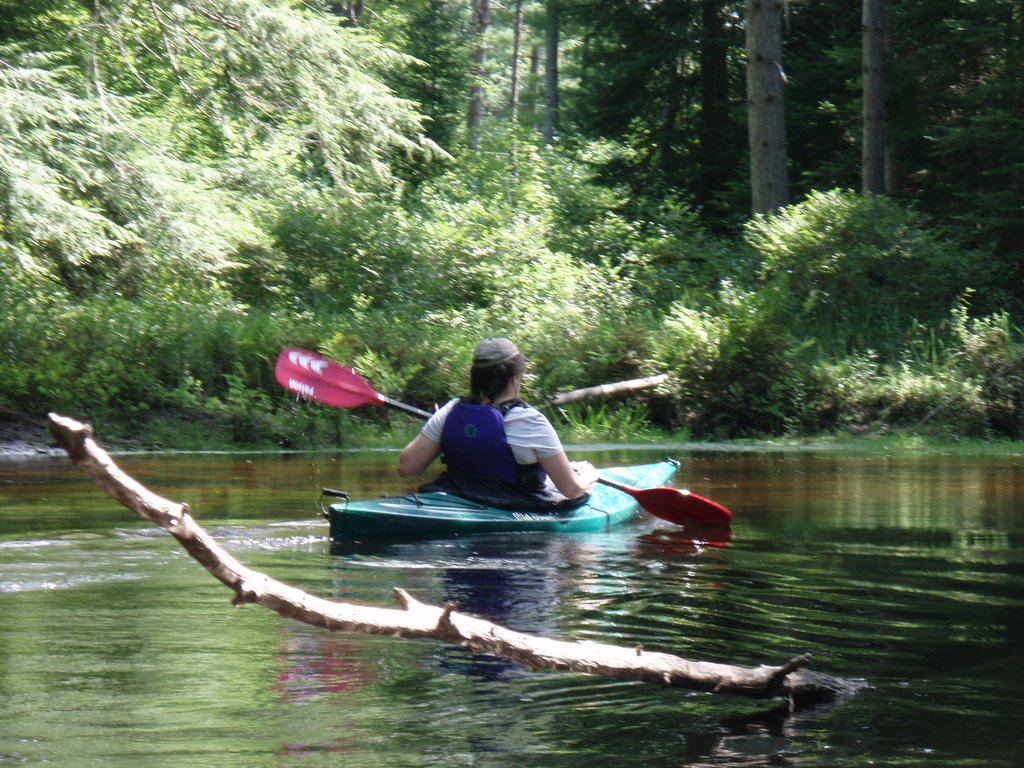 We're headed upstream in this picture with Laurie in the lead. Right around this bend I tried to slip under a leaning tree. Laurie had gone around the end of it. I took a few good digs with the paddle and then held it lengthwise to shoot under the tree. My boat didn't carry far enough, so my left paddle blade caught on the tree as I drifted backwards. The paddle pivoted downwards and got wedged beside the boat. The inexorable current then tipped the boat up and over before I could figure out how to stop it.
The boat was still somewhat wedged, so I had to come out of it to right it. The little FRS radio in my pocket was whining, so I yanked the batteries out of it. Laurie retrieved a couple of escaped items heading downstream.
This is why I shelled out a few hundred for a waterproof digital camera. Stupid things can happen.
Field Testing the Olympus Stylus 720SW
 I took this picture immediately after wading out of the water. I had to sponge the water droplets off the glass over the lens, but the camera worked perfectly. I believe the plant is Lobelia Cardinalis.
Subscribe to:
Posts (Atom)