Monday, August 14, 2006

Just Before

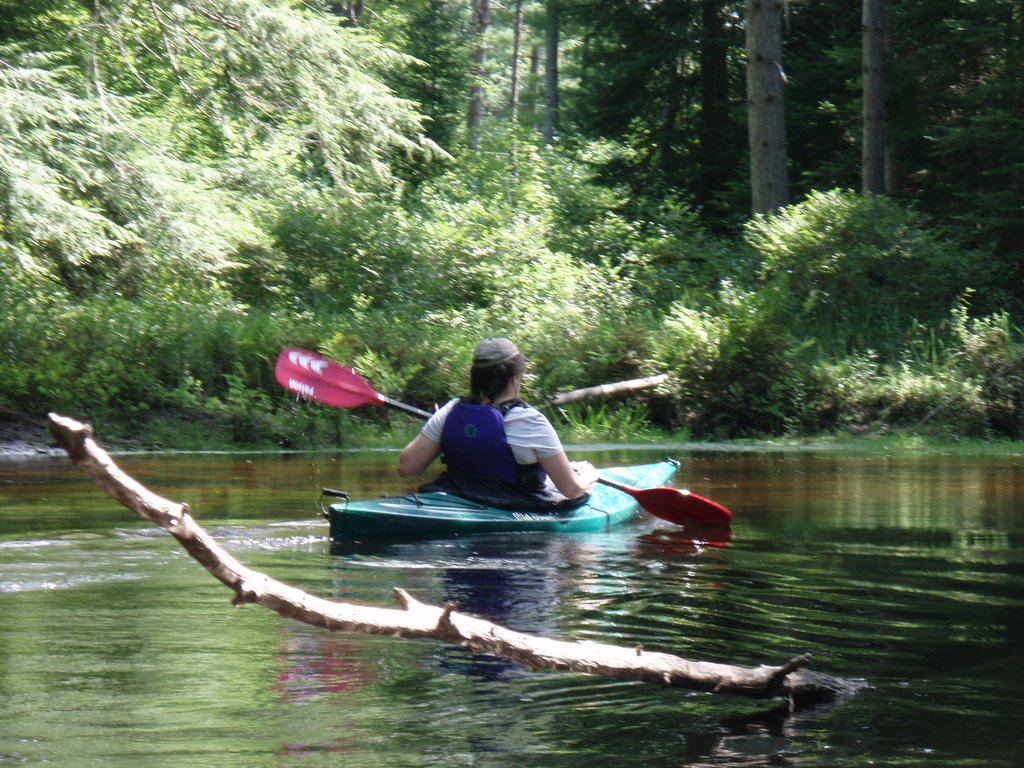
We're headed upstream in this picture with Laurie in the lead. Right around this bend I tried to slip under a leaning tree. Laurie had gone around the end of it. I took a few good digs with the paddle and then held it lengthwise to shoot under the tree. My boat didn't carry far enough, so my left paddle blade caught on the tree as I drifted backwards. The paddle pivoted downwards and got wedged beside the boat. The inexorable current then tipped the boat up and over before I could figure out how to stop it.

The boat was still somewhat wedged, so I had to come out of it to right it. The little FRS radio in my pocket was whining, so I yanked the batteries out of it. Laurie retrieved a couple of escaped items heading downstream.

This is why I shelled out a few hundred for a waterproof digital camera. Stupid things can happen. Posted by Picasa

Field Testing the Olympus Stylus 720SW

I took this picture immediately after wading out of the water. I had to sponge the water droplets off the glass over the lens, but the camera worked perfectly. I believe the plant is Lobelia Cardinalis. Posted by Picasa

Monday, June 12, 2006

Morning on the River

Pine River is bank-full and cold after all the rain we've had. I was down there this morning to test the water for the Green Mountain Conservation Group.

It was strange to see the sun.

The mosquitoes had been hellish as I walked through the woods to get to the river, but they weren't too bad when I got there. Flat swarms of them swirled just over the water's surface, intent on their own business. Dipping down into this motion in parabolic dives were mayflies. The two patterns blended like a dance.

The water is dark brown, but not really silty. The samples I tested for turbidity produced lower numbers than I think I've ever seen.

When I was young I would look down small rivers as we drove across their bridges in the family car on our way somewhere else. I always wondered what I might find along those mysterious, neglected streams. Every time I've followed one I've found something cool.

It's nice to be taking care of a river now. Posted by Picasa

Sunday, May 07, 2006

Holy Quack!

We just spotted a pair of wood ducks perching in a tree behind the garage. They may be house-hunting in the mixed pine forest. According to some quick internet research, they may nest up to two kilometers from the water. We're closer than that and I've seen woodies on the river many times. Some people put out duck boxes for them.

Add that to the list of oddball species that call Scavengewood home. We have forest hummingbirds and wood ducks who don't prefer waterfront.

We won't count the wood ducks as residents until we see them move in.

Frog Finding

On a sunny bike tour around the neighborhood, Laurie and I went down Huntress Bridge Road, a straight mile of dirt across a tamarack swamp. It was too nice a day to hurry.

We stopped to look into the water filling the wetland after the rain last week. Levels are low compared to years when winter's snow was deep, but somehow it manages to flow. The small rains we've received do bring the streams up a little.

At first the little ponds looked sterile. We saw a few water bugs dancing on the surface, but nothing more. Then Laurie, the Frog Finder, began to spot them. There seemed to be a frog or two every few inches. As we walked further, to a wider bit of water, we saw egg masses down near the bottom. It looked like a fairly good day in the frog world.

Monday, May 01, 2006

Playing Outside, Boston Style

This weekend I took a rare Saturday off to go to a concert by the Boston Philharmonic. While in the city, Laurie and I went with our host, Ken, and our friend Genevieve, to a couple of the recreational green spaces in the area.

On Saturday afternoon we went to the path along the Charles River in Watertown for a short stroll. The big story this time of year is birds. Whatever species still have winter habitats anywhere are returning for the spring breeding season here in the northern US. Ken's pretty good with the avian fauna, even identifying them by ear when they can't be seen. Of course none of the rest of us knew enough to call him on any of it. But we did see a nice selection of specimens.

Right by the Watertown Dam we saw a black-backed gull and a herring gull. Nearby we saw a cormorant. Then, as we walked upstream, we saw two beautiful wood ducks. The urban woodies are a lot less shy around humans than the ones we see along the rivers in our part of New Hampshire.

Take a moment for whatever plays on words you can't keep your mind from pursuing.

Along came the inevitable couple of mallards to see what we might be giving away. Further along, at a little boardwalk spur to overlook the bank, some Welfare Geese came up, also hoping for charity. These are the variant of Canadian goose that no longer migrates. There really is something sad about that. Not deeply sad, just disappointing. Come on! Migrate! Your tundra home is calling.

Nope. Not today.

Other species included a goldfinch, yellow-rumped warblers, a grackle, red-winged blackbirds and a stunning northern oriole, looking very freshly painted. There are hardly any leaves out yet, to hide the bright plumage of the males.

The next day Ken took us to Forest Hills Cemetery to see the Great Horned Owl owlets. In the photo he showed us, they looked like little teddy bears with piercing, burning eyes and savage beaks. Cute! Fuzzy! Egad!

When we got to the cemetery, which is also maintained as a public green space, the young owls were no longer in the nest. They're about six or seven weeks old at this point, so they've "branched," as Ken put it. Unable to fly properly, they've hopped out onto the branches and actually manage to go from tree to tree with ungainly, flapping leaps. We searched the area, but did not see them. Laurie pointed out the owl pellets on a flat memorial slab in front of us. For a while that and the empty nest seemed like all we would see.

We did see a titmouse, a mourning dove, another red-winged blackbird and another warbler of some sort before we gave up and started to leave.

On the way out of the cemetery we saw a small group staring into the upper branches of a large tree. One man had a camera on a tripod with one of those lenses only really serious people bother to buy and carry around. The kind that mount to the tripod themselves, with the camera hanging off the end like a vestigial organ. We'd located the owls. Or, more correctly, we'd located the people who had located the owls.

We joined the craning crowd, talking in hushed tones. Two sandy-gray owlets, juvenile in plumage and configuration, but not in size, clung incongruously to tiny twigs in the crown of a tree just unfurling yellow-green leaves. The breeze swayed the crown of the tree, so the owls bobbed and swayed, occasionally putting out a wing to stabilize themselves. They stared solemnly, appraisingly down at us as we looked up at them.

Cool as it is to sight something rare in nature, there's only so long you can spend invading the privacy of a creature whose only interest in you is whether you will try to eat it after it has determined that it is too small to eat you. We soaked up as much owl ambiance as we could, before heading off to find some much-needed lunch.
Thursday, February 23, 2006

More Uplifting, Still with Lightning

Lightning is a serious danger to outdoor adventurers. In the mountains or on the water, the exposure can be terrifying.

One summer day I headed up the Huntington Ravine Trail on Mount Washington, with my friend Stuart. We both like trails that go right into the interesting terrain without a lot of slogging to get there. Since the Huntiongton Ravine Trail is rated as one of the most difficult in the White Mountains, it certainly qualifies.

I had been up the headwall of that ravine several times in the winter, but never in the summer. I had been across the cone of Mount Washington a number of times in winter and warmer weather, so I had a good mental picture of the topography.

The forecast that day called for possible showers and thundershowers. If the weather looked too bad we could turn back from the ravine floor. One problem with the Presidential Range is that the steepest part is in the middle of the climb, so weather can sneak up on the other side of the ridge and suddenly burst over on you. You learn to watch the clouds all the time and listen for any hint of wind or thunder.

We proceeded across the ravine floor and up the talus slope, hiking steadily, but stopping to enjoy the scenery. We saw a glider drop its tow above us and begin to soar freely. It did not linger long. That was hint number one.

The clouds darkened and began to swirl more turbulently as they surged over the ridge above us. Hint number two. It was more than a hint. We had to move toward shelter.

One might instinctively head downward to escape a storm, but there was no real shelter back that way. The trees are short, once you finally reach them. You would actually be pretty exposed until you went quite a way down. No, strange as it seemed, what passed for safety lay slightly up and over to our left, at the base of the cliff. A high arching overhang would keep the worst of the rain off us, while the mass of the cliff would give us the best chance that ground currents from a strike above would dissipate or divert before reaching us. Under this overhang, a smaller rock thrust up to give us a place to perch, so that we would be less vulnerable to ground currents from strikes at or slightly below our level. We hurried over to this refuge, where we squatted on the smaller rock below the big roof and watched the storm come down.

We'd seen a couple of other hikers out on the talus slope, but too far away for us to shout to them. I hoped these others had seen which way we headed, but they never joined us.

The storm passed fairly quickly. Lightning did strike a couple of times on the pinnacle above and the ravine floor below our overhang. Then it all passed and the sun came back out.

We emerged from the overhang and scrambled the rest of the way to where the trail starts up the headwall itself. The clouds continued to disperse, so we eyed the route above. Meanwhile, the other hikers joined us. They were cousins, Meg and Julie. Meg was an economist. Julie was a physical therapist. They were very wet, having followed the instinctive urge to beat feet downwards and found no shelter as the downpour trampled over them. But no one had gotten electrocuted, so we were all game to try the ascent.

The climbing does require a little technique and the use of hands and feet for some moves. It gave us all something to think about as we scrambled up it. At no point are you really dangling above a drop. It's just a fun scramble, where you measure your progress in feet of elevation rather than miles of trail. All the while, the views across the valley toward the Wildcat Ridge just get better and better.

We topped out on the Alpine Garden and congratulated each other. Not only had we made the climb, the weather had given us a break. It hadn't dropped another storm on us when we were stuck in the middle of the steep bit. We hiked on over to Lion Head and scrambled back down to hook up with the Tuckerman Ravine Trail back down to Pinkham. Good conversation made the Tucks Trail less of a boring slog than usual.

Stu, you gotta come back. We have many more wicked steep trails to try.