Idly Googling on a deadly slow day at the shop, I punched in Dolly Sods, then Roaring Plains, two places in which I began my backpacking education.
The Sods was little known when two Sods regulars initiated a couple of us to its mysteries. Most DC area hikers only seemed to go as far as Shenandoah National Park, or perhaps the George Washington National Forest.
Preparing for our first trip, a field trip from the bike shop in Alexandria where we more or less worked, Art and Scotty primed us with tales of a weird landscape, scoured by the wind as the bones of deer and free-range sheep bleached in the weather. We would be far more likely to see animals than people, they assured us. They had been going there since high school, and only saw the people they brought with them on any particular trip.
They were as surprised as we were when we found quite a few people out there on a harsh October weekend. Maybe it was Columbus Day Weekend. I didn't pay much attention to the holidays back then. I only knew that I had a couple of days off and we were going to have an adventure.
By bushwhacking, as was Art and Scotty's habit, we managed to go most of two days without seeing anyone but each other. The landscape certainly lived up to their description. The spruce trees were all flagged by the incessant wind, so they had branches only on their leeward side. Sandstone formations jutted up from the hillsides. We bounced over sphagnum bogs like kids jumping on a giant bed. No water showed. Only the springy mat of thick moss revealed that we weren't on solid ground.
As years passed, I learned more about the disciplines of hiking and met more people who explored the lesser-known areas. One of them, a guy named Jack, pushed into the plateau next to Dolly Sods, an area called Roaring Plains, and discovered many hideaways only an intrepid bushwhacker would find.
By the beginning of the late 1980s, ATVs had arrived out there. The locals laid tire tracks on a lot of what had been pristine and peaceful knolls from which to survey the rumpled mountainscape in quiet contemplation. At the same time, the small numbers of the intrepid grew and grew. It appears from the internet results that this may have generated some efforts to preserve the peaceful beauty against the onslaught of vehicle ruts. The cost, of course, is that none of it is a secret anymore. You don't have to look at a topographic map and deduce for yourself what you may find. You can look at a website and know for sure. I recognized some vistas, now named, with trails, that we found for ourselves with map and compass. There are names, personal and commercial, associated with the things we used to do out there just to do them.
When you visit a place often, or if you live there for a while, you develop a sense of territory. So it was with Roaring Plains, where I spent much of one whole day adding rocks to obstacle walls someone else had started, to try to fence out the ATVs. My companions urged me to give it up and just keep hiking, but I couldn't surrender without a statement. Ultimately, though, I left, and gave the field to them.
Twinges of territoriality return as I look at the pictures on the web. But the only way to hold claim to your territory is to be on it. If you're always on it, no one else can be. The need to possess it or be known for its discovery destroys what made it good in the first place.
But I was there. I peed on a bunch of trees. It's the natural way to claim.
Friday, December 15, 2006


Monday, October 02, 2006
Hunting the Wild Culvert
 Here is our quarry: the wily, elusive culvert.
Road builders release these innocuous-seeming metal or concrete tubes into the wild, letting them nest underneath the roads and highways and, like a neglectful reptile mother, wander off, leaving them to fend for themselves. Later, natural-sciences students go in search of them to see if they are really doing what they were meant to.
Someone must have known where they were originally, but now the most effective way to inventory them and assess their efficiency is to drive very slowly along the road, scanning the undergrowth for any hint that a culvert might lurk down there and then wade through the poison ivy to measure and describe it.
The plucky UNH crew crawls right through the large enough ones. It's not so bad on a warm September day, but the study runs into November.

Monday, August 14, 2006
Just Before
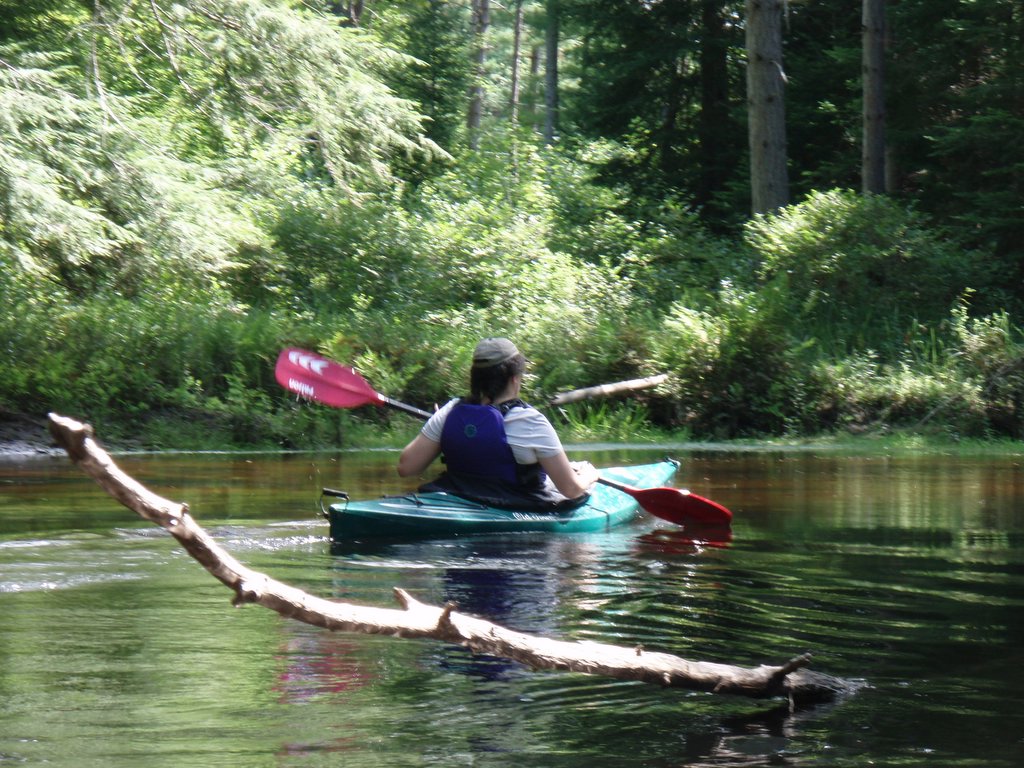 We're headed upstream in this picture with Laurie in the lead. Right around this bend I tried to slip under a leaning tree. Laurie had gone around the end of it. I took a few good digs with the paddle and then held it lengthwise to shoot under the tree. My boat didn't carry far enough, so my left paddle blade caught on the tree as I drifted backwards. The paddle pivoted downwards and got wedged beside the boat. The inexorable current then tipped the boat up and over before I could figure out how to stop it.
The boat was still somewhat wedged, so I had to come out of it to right it. The little FRS radio in my pocket was whining, so I yanked the batteries out of it. Laurie retrieved a couple of escaped items heading downstream.
This is why I shelled out a few hundred for a waterproof digital camera. Stupid things can happen.
Field Testing the Olympus Stylus 720SW
 I took this picture immediately after wading out of the water. I had to sponge the water droplets off the glass over the lens, but the camera worked perfectly. I believe the plant is Lobelia Cardinalis.
Monday, June 12, 2006
Morning on the River
 Pine River is bank-full and cold after all the rain we've had. I was down there this morning to test the water for the Green Mountain Conservation Group.
It was strange to see the sun.
The mosquitoes had been hellish as I walked through the woods to get to the river, but they weren't too bad when I got there. Flat swarms of them swirled just over the water's surface, intent on their own business. Dipping down into this motion in parabolic dives were mayflies. The two patterns blended like a dance.
The water is dark brown, but not really silty. The samples I tested for turbidity produced lower numbers than I think I've ever seen.
When I was young I would look down small rivers as we drove across their bridges in the family car on our way somewhere else. I always wondered what I might find along those mysterious, neglected streams. Every time I've followed one I've found something cool.
It's nice to be taking care of a river now.
Sunday, May 07, 2006
Holy Quack!
We just spotted a pair of wood ducks perching in a tree behind the garage. They may be house-hunting in the mixed pine forest. According to some quick internet research, they may nest up to two kilometers from the water. We're closer than that and I've seen woodies on the river many times. Some people put out duck boxes for them.
Add that to the list of oddball species that call Scavengewood home. We have forest hummingbirds and wood ducks who don't prefer waterfront.
We won't count the wood ducks as residents until we see them move in.
Frog Finding
On a sunny bike tour around the neighborhood, Laurie and I went down Huntress Bridge Road, a straight mile of dirt across a tamarack swamp. It was too nice a day to hurry.
We stopped to look into the water filling the wetland after the rain last week. Levels are low compared to years when winter's snow was deep, but somehow it manages to flow. The small rains we've received do bring the streams up a little.
At first the little ponds looked sterile. We saw a few water bugs dancing on the surface, but nothing more. Then Laurie, the Frog Finder, began to spot them. There seemed to be a frog or two every few inches. As we walked further, to a wider bit of water, we saw egg masses down near the bottom. It looked like a fairly good day in the frog world.
Subscribe to:
Posts (Atom)